Back

Report

PLASTICS: U.S. trade in recyclable plastics materials slowed in the first quarter

2:16 min Facts & FiguresAmerica
Washington, District of Columbia, United States

U.S. trade in recyclable plastics materials slowed in the first quarter of 2026. Exports of recyclable materials—including polymers of ethylene, polymers of styrene, polymers of vinyl chloride, polyethylene terephthalate (PET), and other plastics—totaled $41.0 million. This was 10.4% lower than the previous quarter and 24.6% below the same quarter last year.

Plastics other than PET and PE dominated trade flows

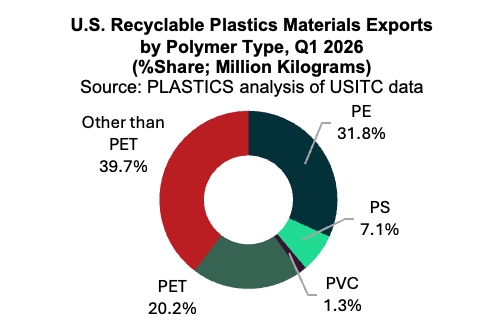
First-quarter export volumes amounted to 90.5 million kilograms, down 7.7% from the previous quarter and 6.5% year-over-year. By quantity, most U.S. exports consisted of plastics other than PET and polymers of ethylene, accounting for 71.5% of total exports, as shown in the accompanying chart.

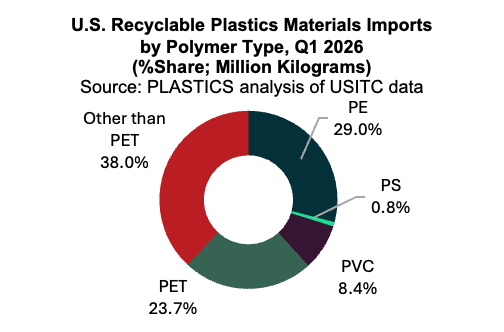
Imports in the first quarter, on the other hand, rose 7.8% quarter-over-quarter to $26.9 million but decreased 60.6% year-over-year (YoY). Import volumes totaled 59.4 million kilograms in the first quarter, increasing 3.5% from the previous quarter but declining 39.2% YoY. Similar to exports, more than half of imports (67%) consisted of plastics other than PET and PE.

Main trade partners in recyclable plastics materials

The main trading partners of the United States in recyclable plastics materials are its USMCA partners: Canada and Mexico. In the first quarter, 37.1% of U.S. exports went to Canada and 17.3% to Mexico, accounting for more than half (54.4%) of total U.S. exports. Together with eight other countries—India, Malaysia, Vietnam, Turkey, Spain, Germany, Pakistan, and El Salvador—these markets comprised 84.0% of total U.S. exports for recyclable plastics materials.

Similarly, most U.S. imports of recyclable plastics materials originated from its USMCA partners, accounting for 61.4% and 22.2%, respectively, or a combined 83.6% of total imports. While the U.S. has largely stopped exporting recyclable plastics materials to China, it continues to import from China. In the first quarter, imports from China totaled 1.3 million kilograms, equivalent to 2.2% of total U.S. imports. Along with USMCA partners and China, imports from Denmark, Vietnam, Germany, Czechia, the U.K., Italy, and Bangladesh brought the combined share of these countries to 97.6% of total U.S. imports.

Domestic recycling gains reshape U.S trade flows

U.S. exports of recyclable plastics materials decreased significantly, falling at a 15.0% CAGR between 2016 and 2025. One can argue that the increased use of recycled materials in the U.S. necessitates greater domestic recycling activity. Meanwhile, U.S. exports of recyclable plastics materials to its USMCA partners increased modestly, rising at a 0.7% CAGR over the same period. At the same time, imports of these materials from USMCA partners decreased by 2.3%.

Outside its USMCA trade partners, China—which had long been both a major export destination and import source—has become a far less active trading partner for the U.S. in recyclable plastics materials. U.S. exports to China declined dramatically following China’s National Sword policy,* which took effect on January 1, 2018, falling at a 53.2% CAGR between 2016 and 2025. While the U.S. continues to import recyclable plastics materials from China, imports also declined, falling at a 7.4% CAGR over the same period.

In 2025, the U.S. recorded a 4.6 million-kilogram trade deficit in recyclable plastics materials with China. Although the U.S. maintained a longstanding trade surplus with China until 2021, changes in China’s import rules for recyclable plastics materials reversed the trade balance in China’s favor. Even so, trade volumes between the two countries have remained relatively low.

Taken together, these trends could suggest that the U.S. continues to strengthen its domestic plastics recycling capacity. While market dynamics will continue to shape recycling activity in support of broader sustainability goals, public policy and regulatory frameworks remain essential to ensuring efficient and well-functioning recycling markets.

_______________

* China’s “National Sword” policy fundamentally reshaped global recycling trade flows beginning in 2018. The policy banned imports of 24 categories of solid waste—including many plastics, unsorted paper, and textiles—effective January 1, 2018, while stricter contamination standards for permitted recyclable materials, capped at 0.5%, took effect shortly thereafter.

_______________

www.plasticsindustry.org

PETnology's Resource Guide
comPETence center

The comPETence center provides your organisation with a dynamic, cost effective way to promote your products and services.

Find out more

Current Magazine Cover
Our premium articles
comPETence
magazine

Find our premium articles, interviews, reports and more
in 3 issues in 2026.

Find out more
Current issue