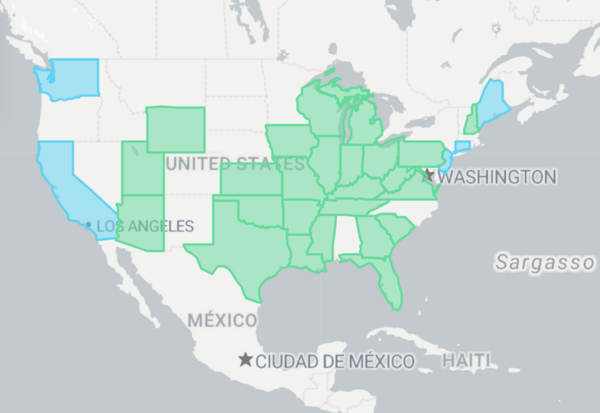
There is no overlap between states that have accepted chemical recycling and those with PCR targets, making it unclear whether pyrolysis will be able to count towards the targets. There is a risk of capacity stagnation for pyrolysis in the US under this decentralized, legislation-driven approach unless clarification and harmonization occur in state laws.
EUROPE
The EU is taking a centralized, legislation-driven approach to recycling, including pyrolysis, with a focus on increasing demand for recycled content.
The EU’s approach is top-down, with legislation implemented at the member-state level. The EU currently has PCR mandates in legislation such as the Single-Use Plastics Directive (SUPD) and the Packaging and Packaging Waste Regulation (PPWR), the latter of which applies from 2030. The primary bottleneck for pyrolysis recyclers in Europe is regulatory clarity. While there is a strong indication from the EU that pyrolysis will be recognized, there remains regulatory uncertainty.
Strengthening the case for pyrolysis acceptance in EU PCR legislation, the European Council voted through the end-of-life-vehicle regulation (ELVR) on 29 June, meaning it will now become law once it is published in the Official Journal of the EU. The ELVR is a major piece of legislation designed to improve vehicle circularity and increase the use of recycled materials in new vehicles, and chemical recycling is accepted towards the targets with the mass balance approach yet to be clarified.
Even if pyrolysis is allowed to count towards recycled content targets beyond the ELVR, the mass balance scheme chosen is of equal importance. Mass balance will dictate how plastic feedstock gets counted in the final plastic products, a topic of particular significance for processes like pyrolysis that produce multiple outputs.
The ICIS Chemical Recycling Supply Tracker shows that the immediate pipeline of announced commercial pyrolysis facilities under construction or commissioning is larger in the EU than in the US. Although both the US and the EU are taking a legislation first approach, the centralized efficiencies and pending PPWR targets in the EU are key drivers for the difference in near-term announced capacity.
According to the ICIS projections, 3.6 million tonnes by 2030 and 7.6 million tonnes by 2040 will be required in the EU to meet the PPWR targets for recycled polyethylene (PE) and polypropylene (PP), including 0.4 million tonnes and 1.2 million tonnes by 2030 and 2040 respectively for contact-sensitive applications.
The acceptance of pyrolysis and the proper implementation of mass balance are critical to unlocking the full pipeline capacity projected in the EU. It is key to giving clarity and confidence to investors funding the projects in the pipeline as well as supporting buyers in committing to offtake agreements to support those capacities scaling in the near term.
ASIA (EXCLUDING CHINA)
Asia is taking an export-oriented approach to pyrolysis.
A large portion of pyrolysis capacity in Asia, specifically facilities aimed at producing recycled plastics from pyrolysis oil, has advanced with the expectation of export demand from Europe via the PPWR. As this demand has yet to fully materialize, much of the pyrolysis oil produced in the region is directed toward refining markets.
Companies targeting exports as their primary source of demand are highly susceptible to the recycling definition and mass balance scheme that may be adopted in the EU. There is also the added risk of imports not counting towards the target, depending on which approach the EU policymakers decide to take.
The SUPD and ELVR, two pieces of legislation in the EU that are actively calling for the use of recycled content, both adopt a more protectionist approach. The former bans imports from counting towards PCR targets until November 2027, while the latter bans imports from counting towards the targets for the first 48 months after entry into force of the legislation, with stringent requirements afterwards set out in Annex XIII. Without export demand or a domestic market for this material, these players in Asia are at risk of capacity delays, cancellations and closures.
CHINA
China is adopting a centralized, legislation-driven approach to pyrolysis, with a focus on increasing the supply of chemical recycling capacity.
Unlike with the other regions, China has explicitly stated their support for the chemical recycling industry in a central legislative text. The Action Plan for the Application and Promotion of Recycled Materials is a national decree in China which seeks to, among other things, “actively carry out the industrialization of chemical recycling of waste plastics”. The plan also adopts a supply first approach focused on building out “the production capacity of high-quality recycled plastics”, as opposed to the demand-oriented approach of PCR content targets.
The clear support and supply first approach has provided pyrolysis recyclers with a launchpad to roll out announced capacity. Notable developments from the ICIS Chemical Recycling Supply Tracker include one of the largest operating pyrolysis facilities to date, with an installed capacity of approximately 200,000 tonnes/year, as well as the more recent groundbreaking of a 150,000 tonne/year plant in Shanghai.
The pyrolysis industry in China has positioned itself as a key pillar in the country’s broader environmental goals. Maintaining this position amid evolving geopolitical tensions and shifting priorities will be key in unlocking the announced pipeline.
CONCLUSION
Legislation is playing a larger role in shaping the development of pyrolysis capacity, but regional pathways are diverging. The EU is emerging as the primary demand driver through centralized recycled content mandates, while the US continues to face a fragmented, state-level framework that introduces uncertainty and may limit investment. Asia is largely positioned to supply future export markets, leaving many projects exposed to shifts in European policy. China stands apart with a more supply-driven approach, supported by clear national backing for chemical recycling.
Regulatory developments in Europe are extending beyond the region, influencing investment decisions and project viability across global markets. The effectiveness of each approach will depend not just on policy ambition, but on how it is implemented. Greater clarity around recycling definitions, mass balance accounting and market access will be key in determining whether announced pyrolysis capacity translates into sustained commercial growth.
Author: Joshua Dill
www.icis.com