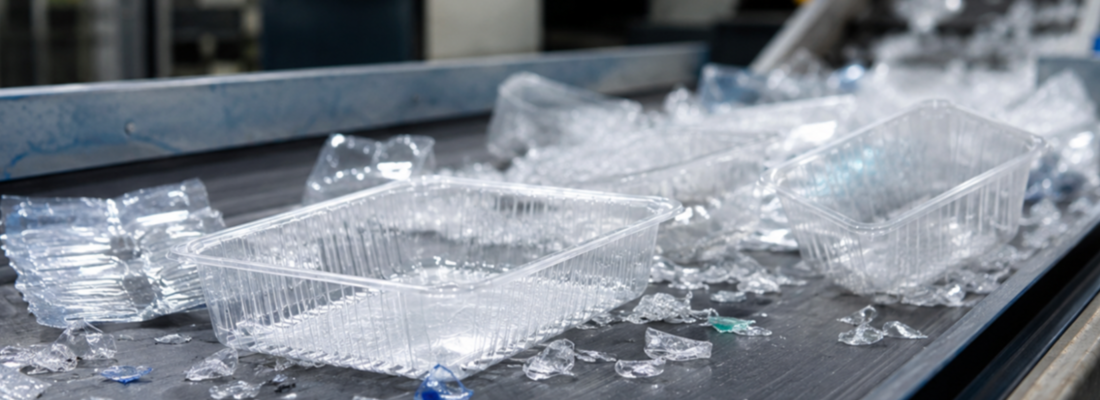
(Photo credit: Forum Rezyklat, AI-generated)

Back

Research

Germany/Europe: Study on PET tray recycling highlights need for action

Cologne, Germany

Forum Rezyklat publishes findings on recycling capacity, sorting, and design for recycling—second phase of the study already commissioned.

PET trays are widely used for fruits and vegetables, sausage and cheese products, and ready-to-eat items. However, they have a significantly lower recycling rate than other types of plastic packaging, despite technologies for sorting and recycling them now being available. This was the conclusion of a study on the recycling of polyethylene terephthalate (PET) packaging in Germany and Europe. Initiated by Forum Rezyklat, the study involved IK Industrievereinigung Kunststoffverpackungen e.V. and was conducted by cyclos-HTP Institute, GVM Gesellschaft für Verpackungsmarktforschung and Fraunhofer Institute for Building Physics IBP.

The study analyses the market volume of PET trays and the existing collection, sorting and recycling infrastructure, as well as the prerequisites for tray-to-tray recycling, in the context of the European Packaging Regulation (PPWR). With an estimated market volume of around 144,000 tonnes of PET trays in 2024, Germany is set to be the largest single market in Europe. The study estimates the combined volume for the 27 member states of the European Union (EU-27) at approximately 824,000 metric tons. At the same time, the study highlights a trend towards monolayer structures instead of multilayer ones, which create more favourable conditions for recycling. The full publication, 'PET Tray Recycling: Status Quo, Challenges, and Future Scenarios – Phase 1”, is available free of charge at www.forum-rezyklat.de/fachpublikationen

Capacity expansion for recycling at scale

In Germany, around 18 per cent of PET trays are currently processed into new recycled material. For plastic packaging as a whole, the figure is around 52 per cent. To meet the PPWR requirements for recycling on an industrial scale, recycling input capacities of around 697,000 tonnes per year would be needed across Europe from 2035 onwards. This means that significantly more PET trays must be collected and sorted by type across Europe in order to come close to meeting this volume. Compared to the current capacity of around 235,000 to 250,000 metric tons, this represents a shortfall of approximately 454,000 metric tons. This corresponds to the output of six to eight large-scale facilities.

The study found that barriers to increasing recycling capacity include the interplay between investment decisions and available material streams, current price differences between virgin and recycled PET, and a lack of long-term purchase agreements.

"The study provides a reliable overview that highlights the current challenges and clearly identifies gaps. It is now crucial to address the identified areas of action along the value chain together,” explains Lisa Marie Ruffert, Circular Consultant at BellandVision and Head of the PET Trays Work Package at Forum Rezyklat.

Technologies are available – 'Design for Recycling' offers concrete starting points

The researchers found that modern sorting technologies, such as AI-powered image recognition combined with near-infrared (NIR) sensors for PET trays, are already available, but have not yet been widely adopted. The study also recommends harmonised sorting standards, as well as clear separation of PET food and non-food packaging into distinct categories, to improve the quality of materials for recycling.

The design of the packaging also influences the conditions necessary for a closed-loop material cycle. The study lists the following as “no-regret” recommendations: avoiding direct printing on trays; using polyolefin sealing films; and using small-area wash-off labels. At the same time, the study clarifies that the two PPWR requirements must be met separately. Packaging can be considered recyclable without sufficient industrial recycling capacity (recycling at scale) being available for it, and vice versa.

Second phase of the study already commissioned

The Forum Rezyklat has commissioned the second phase of the study. This phase will develop technology scenarios for 2030 and 2040, taking 'Recycling at Scale' into account. For each scenario, the study will provide material balances and reliable cost estimates. These will be used to enable a well-founded assessment of the economic viability of different implementation strategies. The aim is to derive specific action plans and recommendations for stakeholders along the value chain, such as 'Design for Recycling' or the further development of sorting specifications.

Key findings of the study at a glance:

  • Market volume in 2024: 144,000 metric tons of PET trays in Germany; Approximately 824,000 metric tons in the EU-27
    - Of these, approximately 121,000 metric tons (Germany) and 730,000 metric tons (EU-27) come from food packaging
  • Germany is the largest single market for PET trays in Europe.
    • Material recycling rate for PET trays: 18 percent in Germany
  • Required recycling input capacity for 2035 for 'Recycling at Scale': approximately 697,000 tonnes per year
  • Current installed recycling/processing capacity is approximately 235,000–250,000 metric tons per year.
  • The calculated capacity gap is approximately 454,000 metric tons, corresponding to about six to eight large-scale plants.
  • Available sorting technologies: - AI-supported image recognition combined with near-infrared (NIR) sensors; Further recommended are harmonised sorting standards and separate PET food and non-food fractions
  • No-regret recommendations for Design for Recycling: Avoid direct printing and use PO sealing films and wash-off labels.

About Forum Rezyklat

Forum Rezyklat was established in 2018 by dm-drogerie markt and describes itself as an agile alliance. With over 80 members, including retailers, product and packaging manufacturers, dual systems, waste management and recycling companies, as well as representatives from academia and politics, the Forum represents the entire circular economy value chain. Together, they work to develop practical, consumer-oriented strategies and measures within the Forum Rezyklat. The goal is to raise public awareness of the circular economy to encourage the sorting of recyclables by type. This will improve the quality of recycled materials and increase the proportion of recycled content in packaging. Furthermore, the Forum aims to optimise packaging and ensure that, from the design phase of new packaging onwards, it is recyclable so that it remains in the cycle as a resource. To achieve these goals, Forum Rezyklat members are actively involved in specialised working groups addressing the following topics: digitalisation, technology and recyclability, communication and economic assessment.

www.forum-rezyklat.de

PETnology's Resource Guide
comPETence center

The comPETence center provides your organisation with a dynamic, cost effective way to promote your products and services.

Find out more

Current Magazine Cover
Our premium articles
comPETence
magazine

Find our premium articles, interviews, reports and more
in 3 issues in 2026.

Find out more
Current issue