Can you guarantee that sensitive customer data will not fall into the wrong hands or become visible to other customers?
Ricker: It’s important to make a clear distinction here. Customer and production data are 100 per cent protected. It is anonymised or neutralised. Under no circumstances must sensitive customer data be shared between customers.
Ricker: The situation is different for certain machine data. For example, if we observe that a particular component tends to reach higher temperatures after a certain period of operation in various regions around the world, this technical insight can be put to use. This type of data is relevant for technological development and is not sensitive, provided it does not allow any conclusions to be drawn about the customer or their production processes. The system must be designed so that no customer data is exchanged. This is one of the major challenges of networked systems.
Trust thus becomes a new level of customer loyalty.
Tischer: We have long-standing relationships with our customers, and this has fostered a great deal of trust over many years. This is a major advantage in this context. As systems become more interconnected, data is shared and utilised jointly, and service models become more closely linked to actual output, suppliers and customers naturally grow closer. Such a model cannot function without trust.
Cost-effectiveness and payback
How quickly does an Ingeniq system, or indeed the entire concept, pay for itself?
Tischer: It varies greatly. This depends on the specific objectives of each customer. Some customers focus primarily on achieving the lowest possible cost per case. Others prioritise maximum output or the greatest possible flexibility. Consequently, the cost-benefit analysis differs depending on the customer and application.
Ricker: However, when viewed over the entire lifecycle, there is significant potential for savings. In certain applications, such as still water, savings of up to 10% on total operating costs are possible. The initial investment is higher because additional automation and digital functions have to be factored in. For those considering total costs and the long-term lifecycle, this approach can pay off after just a few years.
So, the main advantage is increased efficiency?
Ricker: Yes, but in this context, efficiency encompasses several factors: improved performance, reduced energy consumption, optimised material usage and smarter production planning. As part of a holistic approach, coordination with the customer is also important.
Tischer: The aim is to reduce downtime, cleaning times, and unproductive time. In essence, we address all aspects of waste in the production process. Through better planning, greater transparency and targeted optimisation, these losses can be systematically reduced.
Does that mainly relate to management and planning, or does the individual filling machine also consume less energy?
Tischer: This also affects the design and energy consumption of the system. Historically, systems were often designed with additional capacity reserves because faults, buffer times and interruptions were factored in. However, if we can reduce these faults through data, automation and better control, we will need to plan for fewer safety reserves. Machines can be designed to match actual demand more closely while maintaining the same output. This also impacts energy consumption.
Sustainability as a systemic effect
Does the holistic approach reveal new potential that could not have been fully anticipated initially?
Tischer: Yes. A good example of this is the air conveyor and the topic of block systems. Conveyors are also installed as buffers in many systems to absorb disruptions. If a problem arises, these buffers help keep the process stable in the short term. However, if we can significantly reduce disruptions, the system can be redesigned. This raises the question of whether more areas of the line could be grouped directly into blocks. Some conveyors might then no longer be needed. This would result in lower energy consumption, less maintenance and lubrication, reduced space requirements, and less complexity overall.
So, while complexity increases initially, it must also be made more manageable.
Tischer: Exactly. If buffers can be reduced through more stable processes and better data, this will have benefits in terms of space requirements, costs, energy and maintenance. The challenge lies in managing the higher level of system integration in such a way that it does not create new complexity for the customer.
Will Krones use process data as part of its own value creation in future? Will data be monetised to a greater extent?
Ricker: The term ‘monetisation of process data’ can be misleading, so I would use it with caution. Of course, our business must be profitable. However, our primary focus is on using process data to enhance the efficiency, sustainability and performance of our solutions for customers. If there is no added value for the customer, it won’t work for us either.
Ricker: It is important to me that Krones will not become a pure data, IT or software company. We will remain a machinery and line manufacturer. However, data and digital solutions will become an important part of our offering. In certain market segments, there is high demand for data-based services, automation, and holistic service models. In other segments, there is greater reluctance. This is why different models will continue to exist in the future, ranging from individual machines and highly automated lines to comprehensive lifecycle concepts.
Right now, what matters more: steel or data?
Tischer: It’s the combination. Even data won’t result in good systems without outstanding mechanical engineering and process expertise. However, without data, much of the system’s potential cannot be realised.
Is Ingeniq also a tool for managing sustainability?
Ricker: Yes. A line that delivers a higher output can either run for a shorter time or produce more in the same amount of time. This improves specific energy and media consumption figures. Shorter cleaning times, reduced downtime and fewer stoppages directly contribute to sustainability and efficiency. It is important to consider the entire process. Together with the customer, we start with the product and the packaging, and then look at the entire process chain – right through to retail. There are opportunities to unlock efficiency potential at every step, for example in material usage, weight or process design.
Tischer: This also includes energy consumption at the factory level. Peak consumption often occurs because several processes generate high energy demands simultaneously. If this simultaneity is better balanced, the same peak capacities are no longer required. This can be compared to a smart home: if the control system operates intelligently and holistically, energy consumption can be managed more effectively than if each controller operates in isolation. This principle can be applied to a single production line or an entire factory.
How Ingeniq is changing things internally
To what extent is Ingeniq changing development work at Krones?
Tischer: It’s a significant shift. A key difference is the close collaboration between software and digital teams and traditional mechanics right from the start. At the same time, there is great interest on both sides as colleagues recognise its potential. Development processes are changing, too. We’re working on a more international scale as digital teams are often based in other countries, and our working methods are becoming more agile. Sprints and faster iterations are complementing traditional development models.
Does digitalisation also entail a cultural shift within the company?
Ricker: I’m keeping my fingers crossed that it won’t be a cultural shift in the basic sense. We are proud of our company culture, which encompasses how we interact with one another, our customers, and our partners. However, there is definitely a technological and procedural shift. The disciplines are becoming more intertwined. Digital twins, new development systems and data-driven working methods are transforming processes. It is important to bring experienced colleagues on board and combine their knowledge with new technologies.
Tischer: One major issue is the fast pace of change. In the digital world, development cycles are significantly shorter than in traditional mechanical engineering. In the past, major development milestones were often tied to long trade fair cycles, such as drinktec. In the digital world, a huge amount happens in just four years. The challenge lies in reconciling these different cycles.
Does the guiding principle behind Ingeniq also apply to your in-house processes?
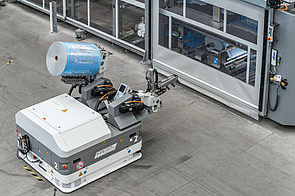
Tischer: Yes, it’s essentially the same principle. For us, too, it’s about using data to automate processes and make workflows more efficient. Autonomous vehicles operate in our production halls and robots assist with assembly and other processes. The fundamental principles are the same: making data available, stabilising processes, increasing efficiency, and enabling greater autonomy step by step.
Is digitalisation generally met with enthusiasm within the company? Or is there also scepticism?
Ricker: As with any major change, there will be both supporters and sceptics. Some people are enthusiastic about driving such initiatives forward. And there are others who ask: Does it really work? What will it mean for me? What will I need to change? This is why it is important to get people on board and keep them well informed. The direction is clear. We shouldn’t hold back those who are leading the way. At the same time, we mustn’t leave those who are still hesitant behind. The added value comes from combining traditional mechanical engineering expertise and practical experience with new digital systems. At the same time, success will depend on our mindset: we need to remain open, curious, and willing to learn, as this will be essential to stay relevant and competitive in the future.
Risk and Success
Where does the greatest risk for Ingeniq lie?
Tischer: With Ingeniq, we are taking on more responsibility for a lines’ output and lifecycle. To be honest, we are mechanical engineers in transformation. Until now, we have been less involved in plant operation. This means that we also have a learning curve when it comes to precise long-term operation. In the past, this risk was sometimes too high for us. However, thanks to digital tools, data and greater transparency, we can now play a much more active role in operations and make more informed decisions. This makes the risk more manageable. Of course, digitalisation still carries risks. However, we are not changing our entire portfolio overnight. Instead, we are introducing such concepts step by step and gaining experience. Overall, we see significantly more opportunities than risks.
How will you measure Ingeniq’s success in five years’ time? Is it by the number of systems installed, or by other metrics?
Ricker: Ultimately, success will be determined by how much volume we can generate with this concept and how attractive it is to the market. Of course, we must also achieve our financial targets. But first and foremost, the key thing is that the customer sees the added value. If we deliver what we set out to do, the customer benefits, creating a win-win situation for us too.
Tischer: Five years is a reasonable amount of time to establish whether a system has found its place in the market. We would consider it a success if Ingeniq were perceived as naturally as the ErgoBloc — if people simply said, ‘That’s logical, that makes sense, that’s the right way to go.’ Achieving that status would be a great success.