PET for Plastic Drums
CYPET: Plastic drums made from pet, as a replacement for metal, HDPE or fiber drums
BACKGROUND
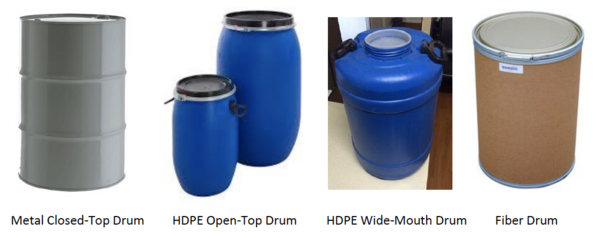
Drums are used for the storage and transport of liquids, powders and granular materials, for a wide variety of applications, like foodstuffs, pharmaceuticals, chemicals, fuels, lubricants, etc. Traditionally metal has been the material of choice, however plastic drums made from HDPE have become very popular and to a lesser extent fiber drums are also used. Sizes vary from 30 litres to 220 litres and various types are available according to the size of opening (open top, wide mouth, closed top).
PLASTIC MATERIALS FOR DRUMS
The tendency of metal drums to rust and the sensitivity of fiber drums to wet conditions, have resulted in the popularity of plastic drums made from HDPE (high molecular weight high density polyethylene). Such drums are manufactured using extrusion blow moulding, a well-established process for the production of HDPE hollow containers. HDPE exhibits the right melt properties for this process and also combines rigidity with impact strength for mechanically sound containers. Other plastic raw materials are either not suitable for processing into hollow containers or do not exhibit the required mechanical properties for strong drums.
The only other plastic raw material that exhibits high mechanical strength and is suitable for processing into hollow containers is PET. In fact, PET is the only plastic strong enough to withstand the carbonation pressure of carbonated soft drinks and is the only plastic used for this application. In addition to its very good mechanical properties, PET also offers transparency and a smooth, glossy surface finish, making it easy to clean. It is also easily recyclable and can be upgraded during the recycling process to bring its properties back to their original levels, including the suitability for food contact applications after recycling.
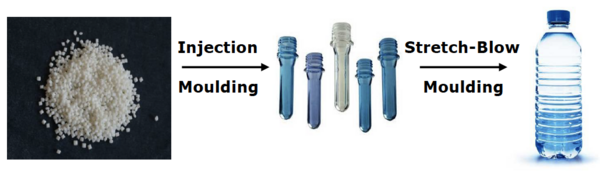
PET cannot be processed with extrusion blow moulding, however a PET container can be produced with injection stretch blow moulding, by first producing a PET preform with injection moulding and then stretch-blow moulding that preform into a PET container as illustrated below. With this process PET bottles and jars have been produced over the past 40 years.
PET containers have very successfully replaced other materials such as metal, other plastics, glass and paper in many applications such as soft drinks, water, milk, juice, household cleaning products, chemicals, edible oils, peanut butter, pharmaceuticals etc., typically in sizes up to 2 litres. More recently PET has also successfully penetrated applications in the 5 - 30 litres size range, like 5 and 10 litre bottles for water and edible oil, 20 litre bottles for water dispensers, 15 – 20 litre stackable PET jerry cans for edible oil and chemicals as well as 20 – 30 litre kegs for draft beer.
PET PROCESSING TECHNOLOGY FOR DRUMS
Machines for PET processing have been commercially available for the production of PET containers up to a maximum size of 30 litres and for such large sizes, there is a restriction on the maximum size of neck diameter (mouth opening). As a result of the non-availability of machines capable of processing PET for drums, this market segment has not been developed for PET, despite the fact that PET drums offer a cost efficient and attractive alternative to HDPE Drums.
Since early 2014 when CYPET Technologies Ltd commercialized its patented single-stage PET processing technology, it is possible to produce PET containers larger than 30 litres, including open-mouth PET drums of up to 150 litres capacity and 400 mm mouth diameter. The CYPET innovative production system, injection moulds the preforms and also stretch-blow moulds them into containers on the same machine, in a way that enables large container production with minimal energy consumption.
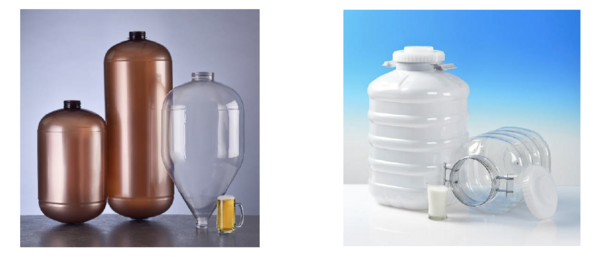
The world’s first 50 litre PET container is a beer keg, which is in commercial production in Australia on a CYPET K 53 machine model. The world’s second 50 litre PET container is a milk drum with innovative built-in handles, which is in commercial production in Kenya on CYPET K 38 machine model.
PET DRUMS PROPERTIES
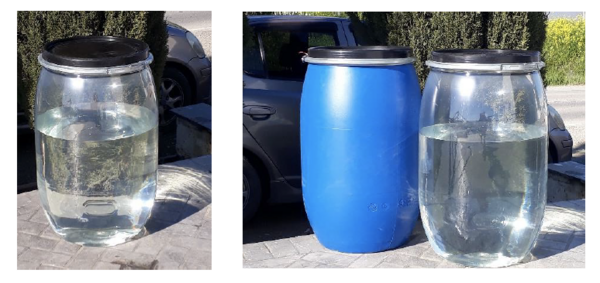
The main advantage of PET drums is their lower weight. PET drums would have about half to two-thirds of the weight of an equivalent HDPE drum. This is made possible because of the superior mechanical properties of PET vs HDPE. This will generate an enormous saving in raw material, with important economic, logistical and environmental benefits, especially for export oriented industries. This lower weight makes the shift to PET drums a very attractive option.
In addition to the weight reduction, PET drums can be transparent, which may be preferable for specific applications. Furthermore, due to the orientation of the PET molecules during the stretch blow molding process, PET drums provide very good alcohol and essential oils barrier properties as well as a high degree of impact resistance. Additionally, the smooth, glossy surface finish provides an attractive appearance and also allows for easy cleaning when required.
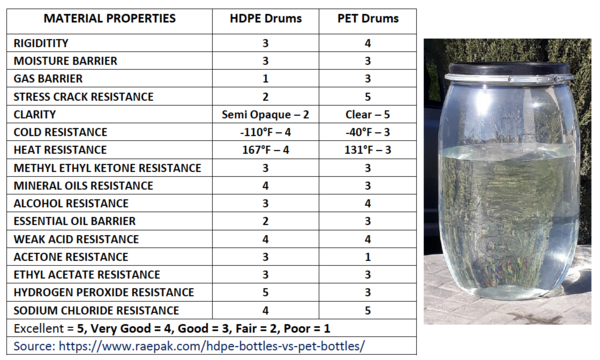
Further material Properties of PET drums compared to HDPE drums are listed in the following table
PET DRUMS FOR THE BULK DRUGS INDUSTRY
Pharmaceutical companies purchase bulk drugs in open mouth drums, usually made from HDPE. These drums are normally lined with a PE bag, in which the powder or granular bulk drugs are filled. This enables the pharmaceutical companies to pull the liner out of the drum and take the ‘clean’ liner into their clean area for processing. It is important, therefore, that the drum design allows for an open mouth.
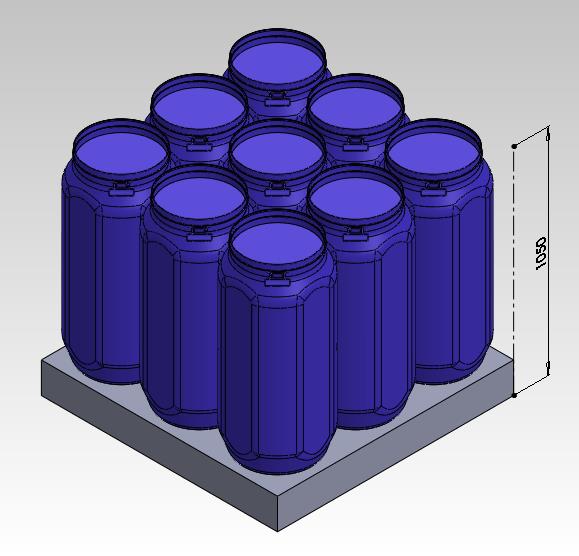
Bulk drugs are normally exported from the country of manufacture to the country of use, so the packaging should present an efficient logistics solution for export in 40ft containers. The currently used HDPE drums of about 80 – 100 litres size, fit 5 on a pallet with 40 pallets in a 40 ft container (2 layers of 20 pallets each). This allows the loading of 200 drums per 40ft container.
CYPET Technologies has designed a 100 Litre PET drum, which fits 9 per pallet, allowing the loading of 360 drums per 40ft container. This represents an increase of logistics efficiency by 80%, with corresponding reduction in shipping costs. Additionally, integrated handles can be provided for easier handling of the drums, including lifting by two persons (100 litres of bulk drug would weigh about 50 kg).
There is additionally a significant saving to be made on the drum cost, which would have a weight of about 1.8 kg, compared to 2.4 kg for HDPE. This is a saving of 25% on raw material, with both economic and environmental benefits.
Additional benefits of PET drums for bulk drugs applications include the smooth and glossy surface finish that allows for easier removal of the liner, the possibility of having transparent drums if required and the full and easy recyclability of the drums at the end of their life.
CONCLUSION
With the commercial availability of PET processing machines by CYPET Technologies, capable of producing PET drums, there is an opportunity for substantial savings in raw materials by shifting from metal or HDPE drums to PET drums, considering the following benefits of PET drums:
- Lower weight (less material)
- No rust
- Transparency
- Smooth, glossy surface
- Food Grade
- Better impact strength
- Better gas barrier
- Better stress crack resistance
The comPETence center provides your organisation with a dynamic, cost effective way to promote your products and services.
magazine
Find our premium articles, interviews, reports and more
in 3 issues in 2026.