The two companies have jointly developed a tray structure that embeds recycled PET flakes within the core, while applying virgin food-grade PET to the outer layers. The design matches the performance — food safety, optical clarity, sealing — that brand owners and regulators require, while substantially increasing recycled content. Most importantly, the tray also remains recyclable after use, creating a material-to-material circular loop that keeps PET in high-value applications.
This initiative helps to position Europe at the forefront of sustainable packaging, offering retailers and brand owners a scalable drop-in alternative to downcycling. The solution fully aligns with future recyclability and recycled-content requirements under the PPWR, including the target of reaching an average of 30% recycled content in plastic packaging by 2030.
Turning a challenge into a circular solution
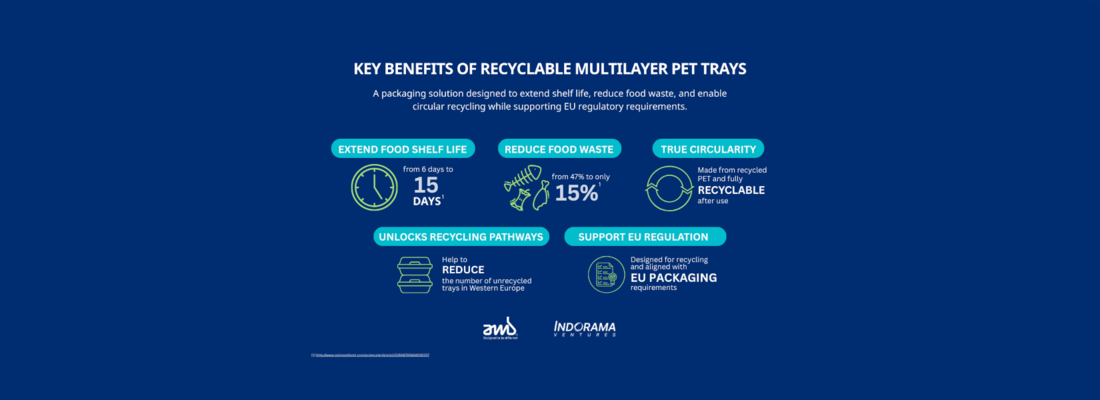
Multilayer trays are essential in protecting food products, extending shelf life and reducing food waste. A 2024 case study showed PET Trays extended shelf life from 6 to 15 days, reducing average food waste from 47% to 15%1.
While PET trays deliver strong shelf-life performance, the next frontier is ensuring that more of this valuable material stays in circulation. Today, around 30% of PET trays in Europe are collected for recycling2— a rate that is set to rise as innovative technologies and industry partnerships such as these take hold. To fully unlock this potential, developing effective recycling pathways for multilayer trays is essential to reducing waste and lowering greenhouse gas emissions.
“This solution demonstrates that multilayer trays can meet circularity goals in practice, not just on paper,” said Paolo Cescutti, Chief Procurement Officer at AMB Spa. “It proves that innovation and collaboration can unlock new recycling pathways, even for the most complex packaging waste streams.”