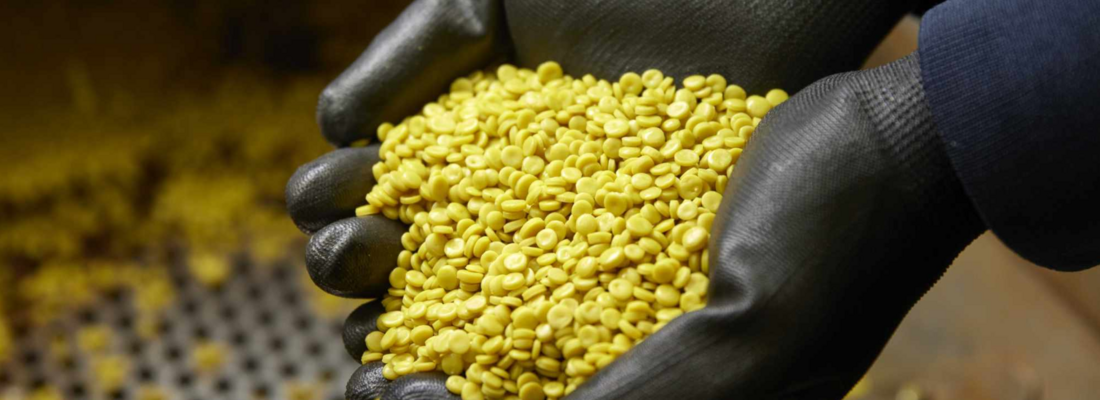
“Anyone who manufactures packaging should also take responsibility for its next life,” says the industry expert. Recycling has been firmly established at ALPLA for more than 25 years. The goal: a used package becomes a new product of equivalent quality – following the bottle-to-bottle principle for PET. Worldwide, ALPLA's 13 recycling plants produce 300,000 tons of rPET and 100,000 tons of rHDPE annually for cosmetics, household cleaners, and oil bottles.
Guaranteed purity: “… down to each individual batch”
The combination of production and recycling gives ALPLA a unique selling point: the company knows the requirements of fillers and brand owners firsthand and thinks in terms of raw materials rather than waste. “We want to set a benchmark for recycling quality in the market,” emphasizes Georg Lässer. “That's why customers come to us. They know they get good service, top quality, a global presence, and a technological edge.” The purity of the recyclate is verified through criteria such as color, impact strength, and viscosity, using controlled processes and strict certifications. According to the recycling expert, “every process step can also be traced back to the individual batch and supplier.”
ALPLA also aims to avoid downcycling. The company sells recyclates back to the packaging industry, where possible to maintain the bottle-to-bottle loop. Unlike in the fiber industry, where plastic is often processed into textiles that can no longer be recycled and have no further life cycle, even by-products that do not meet color requirements remain in the technical recycling loop. They are processed into durable applications such as strapping bands. This way, at least the same mechanical properties as those of a recycled bottle are preserved.
Challenging market: “… often compares apples to oranges”
In Europe, recyclate currently costs 20 to 50 percent more than virgin material. Georg Lässer makes it clear that, “the market often compares apples to oranges.” Recyclate must meet the highest standards but is much more complex to produce. At the same time, it offers environmental benefits, which is why virgin and recycled plastics should not be treated as equivalent. “However,” Georg Lässer points out, “when virgin material prices are higher, recycling becomes somewhat easier from an economic perspective.”
In addition, EU regulations are extremely complicated, and effective enforcement against violations is lacking. At every step, companies have to “ask the lawyers.” ALPLA has invested heavily and is now waiting “for consistent enforcement.” Because brand owners are speculating on the 2028 review of the Packaging and Packaging Waste Regulation (PPWR), they are reducing their recycled-content targets to cut costs – in some cases from 50 to 30 percent or even to zero. This removes thousands of tons of demand from the market. “That's the situation we're facing at the moment,” explains Lässer. Yet investments require certainty: “You only start investing, of course, if you have planning security.”