
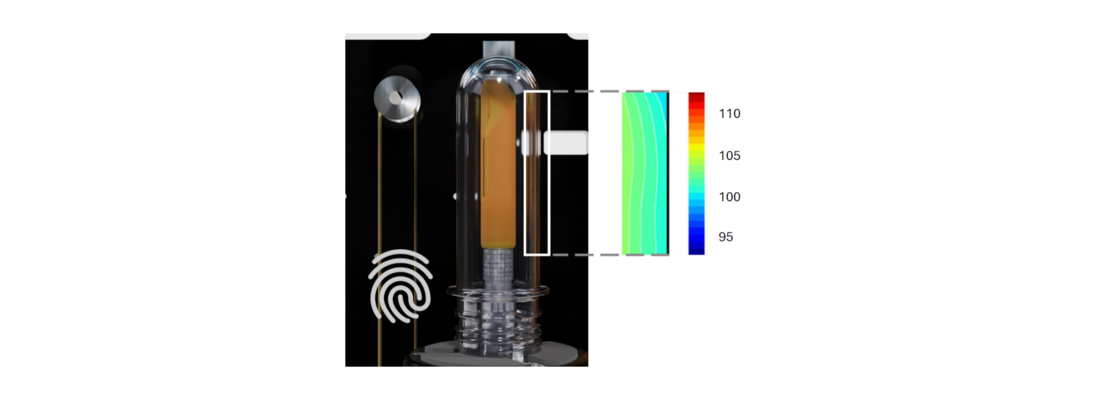
Even with the same stretch blow moulding (SBM) recipes, differences introduced during injection moulding can affect how preforms respond to heating, leading to inconsistencies in the final product. By making the true thermal profile of the preform visible, THERMOSCAN enables more consistent and stable outcomes.
Although the process may appear stable, variations in preform behaviour can still lead to inconsistent results. As the use of recycled PET (rPET) increases and lightweighting tightens the process window, this variability becomes more difficult to manage.
THERMOSCAN measures both internal and external temperatures of preforms along their full length, capturing the complete thermal profile rather than relying on oven setpoints or surface readings alone. This makes visible the parameter that directly governs stretch behaviour: how heat is distributed through the preform wall.
Standard process controls, such as oven setpoints, do not guarantee a consistent internal preform temperature. As a result, materials that appear identical in specification can enter the stretch process in different thermal states, creating variation that is not visible through conventional measurement methods.