(Photo credit: NAPCOR)

Back

Report

NAPCOR releases 2025 PET Recycling Report, highlighting record recycled PET use in bottles and declining bottle recycling rates

Middleton, Wisconsin, United States

The National Association for PET Container Resources (NAPCOR) today announced the release of its 2025 PET Recycling Report, providing a comprehensive analysis of polyethylene terephthalate (PET) plastic recycling in the United States and North America. The annual report examines PET plastic bottle collection and recycling rates, PET thermoform recovery, recycled PET (rPET) end markets, and evolving market dynamics affecting the recycling industry.

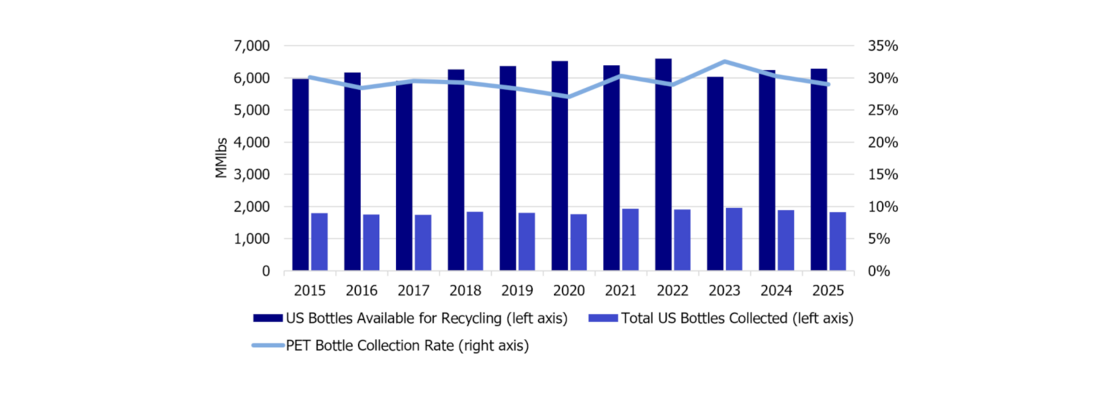
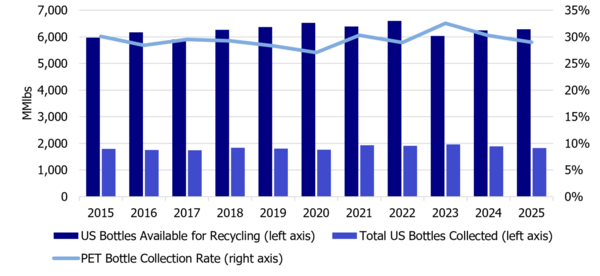
The report found that the US PET bottle recycling rate fell to 29.0% in 2025, down from 30.2% in 2024. Total post-consumer PET bottles collected for recycling in the US declined for the second straight year, down 3.6% from 1,889 million pounds in 2024 to 1,821 million pounds in 2025. Meanwhile, the amount of PET bottles available for recycling increased by 0.6%, from 6,248 million pounds in 2024 to 6,286 million pounds in 2025.

The North American PET bottle collection rate, encompassing the US, Canada, and Mexico, was 36.0%, down from 39.2% in 2024. North America’s PET bottle collection rate has remained above 30% every year since NAPCOR began tracking it in 2019, exceeding the threshold the Ellen MacArthur Foundation set to show that recycling works “in practice and at scale.”

“Our 2025 PET Recycling Report demonstrates growing demand for recycled PET plastic, particularly in new bottle applications, alongside significant challenges to grow collection and processing of material here in the United States,” said Laura Stewart, Executive Director of NAPCOR. “More recycled PET is being used to make new bottles than ever before, and average recycled content in US PET bottles has reached an all-time high. These milestones demonstrate the progress and potential of PET’s circular economy.”

Despite declining PET bottle collection rates, the report identifies key growth areas and shifting demand across the PET recycling value chain.
Key findings from the 2025 report include:

  • Record recycled PET use in bottles and recycled content: 69% of PET recycled in the US and Canada was used to make new PET bottles in 2025, the highest level ever recorded. Average recycled PET content in US bottles also reached an all-time high of 9%, up from a revised 20.7% in 2024. (Note: Some 2024 figures have been updated since publication of the 2024 PET Recycling Report, reflecting new information received.)
  • Increased PET thermoform reclamation: US and Canadian reclaimers processed a record 226 million pounds of post-consumer PET thermoforms in 2025, even as total thermoform collection, including exports for recovery, declined from 264 million pounds in 2024 to 247 million pounds in 2025. The decline reflects fewer exports, while increased domestic reclamation demonstrates continued progress in recovering PET packaging beyond bottles.
  • Growing demand for recycled PET: Total rPET sales to US and Canadian end markets increased 6% compared with 2024, with the growth driven entirely by imports.
  • Shifting import dynamics: Imported rPET accounted for a record 1% of total rPET use across US and Canadian markets, up from 35.5% in 2024, highlighting unprecedented competition for domestic PET reclaimers.
    The report’s findings also reflect significant changes in the economics of domestic PET recycling, with implications for reclaimers, packaging manufacturers, and the broader supply chain.

“We are pleased to see that bottle-to-bottle recycling has reached unprecedented levels,” stated Tom Busard, NAPCOR Board Chair, Chief Polymers and Recycling Officer for Plastipak Packaging, Inc., and President of Clean Tech, Plastipak’s recycling affiliate. “We are concerned, however, that to meet these new heights, the industry has had to resort to more imported rPET due to a loss of domestic reclamation capacity and pounds processed. A strong domestic recycling industry is essential to maintaining a reliable supply of high-quality recycled material and supporting American manufacturing.”

“A circular economy depends on strong domestic systems that collect, process, and reuse materials close to where they’re consumed,” added Laura Stewart, Executive Director of NAPCOR. “Growing reliance on imported recycled PET undermines the domestic infrastructure needed to keep PET in circulation and limits growth opportunities. Harmonized extended producer responsibility programs, expanded deposit return systems, and federal incentives for recycling infrastructure can help strengthen domestic reclamation capacity and build a more competitive, resilient US recycling industry.”

www.napcor.com

PETnology's Resource Guide
comPETence center

The comPETence center provides your organisation with a dynamic, cost effective way to promote your products and services.

Find out more

Current Magazine Cover
Our premium articles
comPETence
magazine

Find our premium articles, interviews, reports and more
in 3 issues in 2026.

Find out more
Current issue