”What counts is on the field.” This old saying from the world of soccer, although slightly altered, also applies to the packaging industry, for which it would be: “What counts is on the shelf.” Because whenever new low weights for PET bottles are being announced, it is worth taking a closer look and questioning the provided information. For example, when it comes to containers for milk products. Ultimately, the deciding factor is sustained success on the market. The PRElactia® system from Netstal has been successful for years.
Anybody who wants to fill milk into plastic bottles has to make many decisions. HDPE or PET? If PET, then one, two or three layers? Which options are even suitable for the desired expiration date class? And what is best from an economic perspective?
In many parts of the world, HDPE packagings remain widely popular even though they have some significant disadvantages. For example, their large weight. In addition to the approximately 30 grams needed for a one-liter bottle, production requires 30 percent more material and energy – and the raw material price is significantly higher than that of PET. HDPE also has a 20 times lower oxygen and CO2 barrier effect. Lastly, the design limitations of extrusion blow molding are quite severe, which is a significant problem in an era in which optical differentiation is in high demand in all consumption areas.
Once a decision in favor of PET has been made, the question of the layers must be settled. There are some single-layer preforms that, at first glance, appear to be unbeatable lightweights. Recently, it was announced that the weight had been reduced to 20 grams per liter of milk. However, that low weight is achieved with a 32-millimeter thread, which is not very popular on the market (38 millimeters are standard) and without information on whether the bottle can be filled with ultra-high temperature treated (UHT) milk – the queen of expiration dates. It convinces with a shelf life time of up to six months and thereby surpasses fresh and so-called “extended shelf life” milk (approximately 21 days) by far. Single-component preforms offer a supposed advantage: They can be manufactured with existing production lines and therefore without investing in a new mold or a new machine. However, there is also a downside that quickly negates the anticipated savings: Single-layer preforms require a large amount (at least 15%) of additives (generally titanium oxide) in order to achieve the same protective effect against incoming light as preforms that have multiple components, of which one is specifically designed to assume a barrier function. These additives are expensive. Assuming a production amount of 70 million preforms and a preform weight of 20 grams, the consumption of additives amounts to 210 tons. At a price of Euro 7.50 per kilogram that adds up to Euro 1.5 million per year!
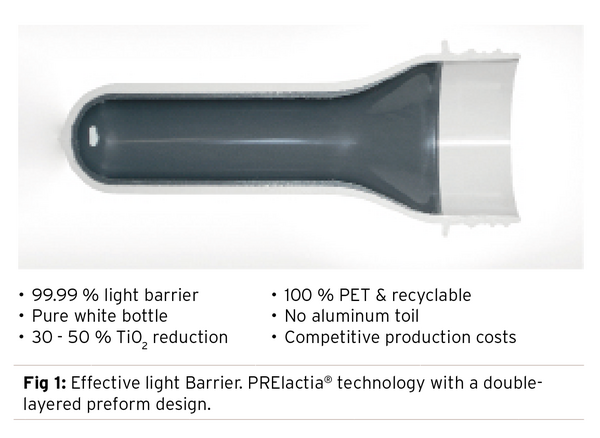
The PRElactia® technology from Netstal therefore uses a double-layered preform design featuring a gray interior wall that is impervious to light and a white outer skin. Both consist entirely of PET, which means that the bottles are fully recyclable. The preform is created by injecting the materials at the same time but in different cavities. The cold side of the mold then transports the initial gray preforms to the next cavity, where they receive the white coating after the parts-removal unit feeds the already completed preforms to the post-cooling. The gray barrier layer is defined precisely and it is fully effective with a low additive share of only five percent: 100 percent of the light with the relevant wavelength of 650 nanometers is blocked.
With its weight of 24 grams, the PRElactia® bottle has proven itself for years and is popular in Europe, Latin America and South America because of its quantifiable advantages. Once again assuming an annual output of 70 million, a manufacturer will save Euro 960,000 on material costs alone compared to an HDPE bottle (calculated with an average PET raw material price of Euro 1,150 per ton). And compared to 24-gram single-layer packaging, the financial advantage as a result of additive savings jumps to Euro 1,386,000. Add to that the safe and proven suitability for UHT milk.
If you have the choice you have to decide
Another preform production design even uses three PET layers, of which the middle one functions as the light barrier. These layers are created in the so-called co-injection process, which means that they are injected wet in wet one after the other. The thickness of the barrier layer is consequently not precisely reproducible and varies from bottle to bottle. Also well known on the market is an application with a preform weight of 29 grams – which translates to additional material costs compared to PRElactia®. Coatings applied to the PET bottles later – mostly on the inside, for example with plasma – can be used for other beverages but are not suitable for ultra-high temperature treated milk.
Our viewpoint on “shelf suitability”
Netstal’s PRElactia® technology is the only process today that has proven its “shelf suitability” for UHT milk in 24-gram bottles while also possessing economic benefits.
The comPETence center provides your organisation with a dynamic, cost effective way to promote your products and services.
magazine
Find our premium articles, interviews, reports and more
in 3 issues in 2026.