Highlights at the international gathering of the packaging industry include
- the deep-learning-enabled HEUFT reflexx A.I. X-ray image processing, which, when detecting glass in glass, makes the invisible visible even in structured, inhomogeneous products such as pickled gherkins and intelligently distinguishes critical from non-critical findings,
- the HEUFT eXaminer II XAC uses deep-learning AI in pulsed X-ray inspection to achieve full coverage, sensitivity and assessment power when examining filled food jars, particularly in the challenging task of glass-in-glass detection,
- the Multi Colour Image Processing, which now provides complete coverage of the finish areas of wide-mouth jars and even fully reveals the finest cracks on the sealing surface,
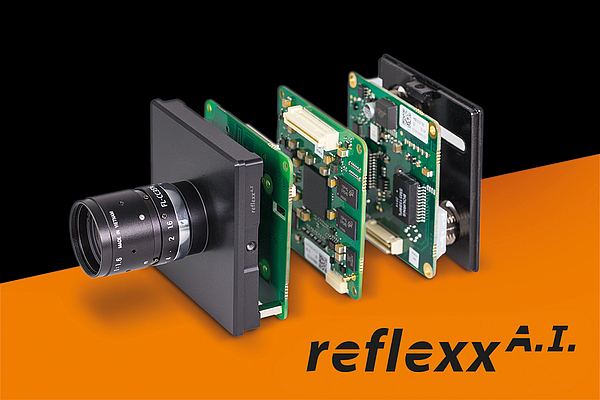
- the HEUFT reflexx A.I. camera, which, in combination with deep-learning-enabled image processing, now evaluates product markings such as best-before dates more intelligently and verifies them reliably even when they are distorted, smudged or blurred,
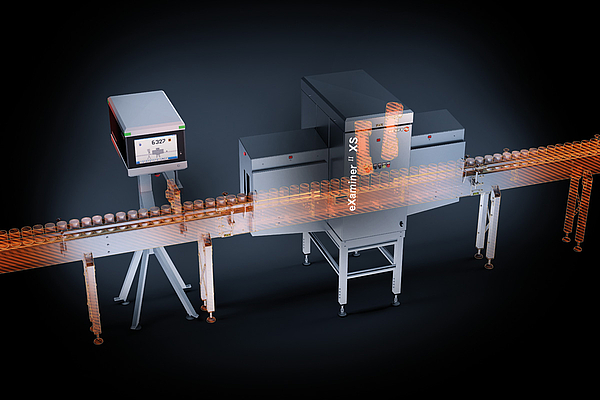
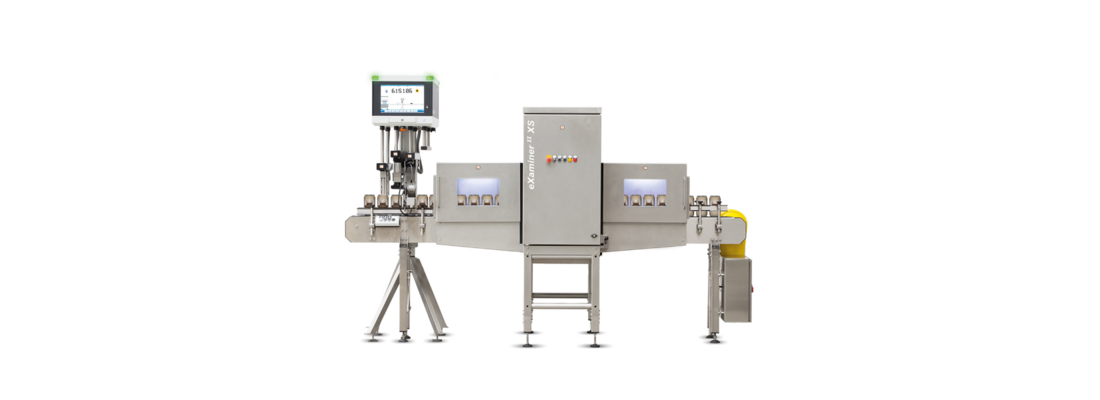
- the compact HEUFT eXaminer II XS, which achieves full detection reliability with a further reduced false rejection rate in foreign body detection in full containers, such as tins, using pulsed X-ray and HEUFT reflexx A.I.
- the lateral laser profile measurement, which detects even the smallest leaks during integrity testing of filled cardboard composite packaging,
- state-of-the-art IT solutions, ranging from production data acquisition and line analysis through to brand and recipe management and end-to-end track & trace, ensuring the necessary efficiency, overview and traceability in the filling and packaging process.
Deep learning X-ray image processing
Thanks to deep learning, X-ray image analysis with HEUFT reflexx A.I. now goes even deeper. It reveals what was previously invisible and reliably distinguishes critical foreign objects from non-critical structures and objects.
Whether pickles or red cabbage in a food jar, cereal, or pasta: even with HEUFT’s proprietary, in-house-developed hardware and software for intelligent image processing, high-density foreign objects such as glass splinters or metal fragments were not always clearly detectable in the X-ray image of a random batch of such structured products. The AI, which it has been using for more than ten years to not only identify a wide variety of objects but also to classify and intelligently evaluate them in a multidimensional process, reached its limits with such structured products. This is changing with the latest HEUFT reflexx A.I. version for the intelligent processing of X-ray images: Using deep learning, it makes previously invisible features visible during evaluation and identifies the tiniest foreign bodies and defects even where this was previously impossible: in non-homogeneous product masses with cavities of varying sizes between their individual components – and with irregular structures that absorb X-ray pulses to varying degrees.
Thanks to the new deep learning algorithm, the aluminium fragment among the pickles can now be detected just as reliably as the glass fragment in the jar of red cabbage, the wire in the muesli, or the ring-shaped piece of cable in ring-shaped pasta of the same size. HEUFT reflexx A.I. detects and marks dangerous foreign bodies in real time – whilst reliably distinguishing them from harmless product and packaging structures, so that the false rejection rate in pulsed X-ray inspection continues to approach zero.
Proven image analysis and AI methods have been combined with a multi-layered neural network that delves deeper and thus processes even abstract patterns independently in a meaningful way. The deep-learning-capable HEUFT reflexx A.I. is thus significantly superior to traditional analysis methods such as grey-scale determination, contrast detection and machine learning for the identification and classification of different objects.
What was previously invisible becomes visible, the rate of false rejections of products that are actually uncontaminated is significantly reduced once again – and no more valuable packaging or food is wasted.
Deepened glass-in-glass detection
Deep learning for intelligent X-ray image processing with HEUFT reflexx A.I. deepens the detection reliability of pulsed X-ray inspection using the HEUFT eXaminer II XAC. With a further reduction in the false rejection rate, previously invisible objects become now visible for the first time.
The current X-ray components, which are developed and manufactured in-house, boost the HEUFT eXaminer II XAC's performance and sensitivity when it comes to detecting filled food jars contaminated with glass splinters and other high-density foreign objects. When combined with the deep learning technology for denoising X-ray images, which has been available for some time, the HEUFT eXaminer II XAC can halve the size of objects it can detect at the end of the line. New deep learning algorithms in the HEUFT reflexx A.I X-ray image processing take this a step further. What was previously invisible becomes visible for the first time, and critical defects are distinguished from non-critical ones even more reliably.
This applies to both the double-base inspection and the 360° sidewall inspection, which, when combined, provide complete coverage of the entire container volume. At major food manufacturers such as Carl Kühne KG, appropriately equipped HEUFT eXaminer II XAC systems are already demonstrating their strengths when it comes to getting to the bottom of foreign objects and reliably distinguishing them from harmless product and packaging structures.
Particularly with non-homogeneous products such as gherkins or red cabbage, which contain components that absorb X-rays to varying degrees and have cavities in between, glass-in-glass can be identified even when it is no longer visible to the naked eye or appears extremely similar in shape and size to non-critical product features on the X-ray image.
HEUFT reflexx A.I. thus identifies truly critical contaminants even more reliably – and removes only those food jars that are actually contaminated from circulation. This reduces the false rejection rate and thus prevents packaging and food waste, along with the associated follow-up costs.
To achieve this, HEUFT has combined proven image analysis and AI methods with a multi-layered neural network that delves deeper and thus processes even abstract patterns independently in a meaningful way. The deep-learning-capable HEUFT reflexx A.I. X-ray image processing system is thus significantly superior to both traditional analysis methods such as grey-scale determination or contrast detection, as well as simple machine learning. Even under challenging environmental conditions, it makes previously invisible defects visible and minimises the rate of false rejections
Intelligent wide-neck jar finish inspection
HEUFT’s Multi Colour Image Processing (MCIP) now enables comprehensive inspection of all types of wide-mouth finishes and improves the reliability of finish defect detection.
In-house developed MCIP significantly enhances detection performance during the finish inspection of food jars prior to filling. Even wide-neck openings of varying shapes and diameters can now be inspected with full coverage. Actually, the finest cracks on the surface, which could lead to dangerous glass breakage, are reliably identified during all-surface empty container inspection with HEUFT InLine II systems.
To this end, the systems engineers from the Vulkaneifel region have directly integrated the structured MCIP lighting into their HEUFT reflexx A.I. cameras. From a single perspective, it combines different illumination scenarios such as bright-field and dark-field illumination in transmitted and reflected light. his is done in different colours to spectrally separate the resulting information and to combine the individual colour channels in such a way that a wide variety of features can be identified on the detection images.
They contain fewer interfering structures and produce a reflection ring on the mouth sealing surface that is twice as large as before. Where this ring is interrupted or blurred, there are notches and cracks, which are intelligently detected in real time by the HEUFT reflexx A.I. image processing system and automatically flagged as critical defects.
At HEUFT’s interpack stand, the new possibilities for wide-neck finish inspection will be demonstrated at a dedicated Enlightenment station.