Building on the 2025 pilot project, the Alliance is transitioning to business-as-usual operations to source rPET pellets for HaadThip’s beverage packaging, supporting its sustainability goals while addressing volatility in the PET market arising from the situation in the Middle East. The Alliance will also expand its collaboration with communities, collectors and local recycling networks across Southern Thailand strengthening readiness for Thailand’s future Extended Producer Responsibility (EPR) framework and its requirements for collecting post-consumer packaging.
A proven bottle-to-bottle recycling model
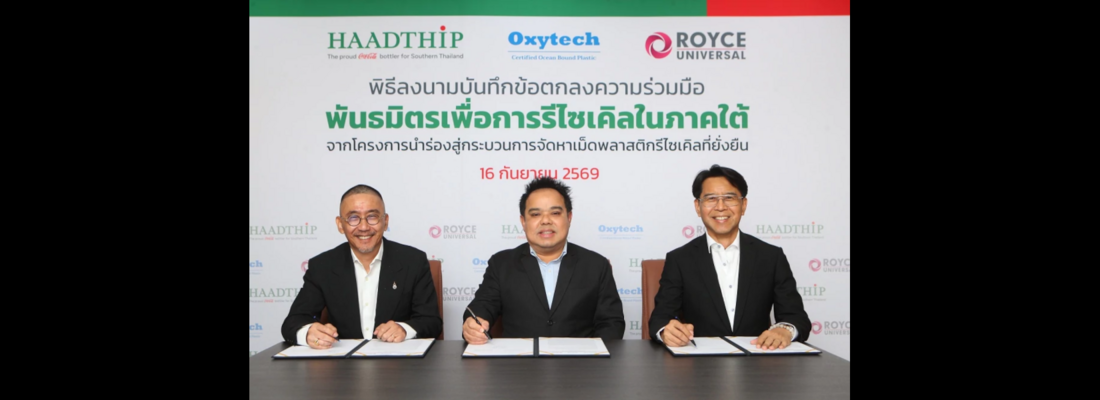
On September 16, 2026, HaadThip signed a Memorandum of Understanding with Oxytech and Royce Universal to transition the Southern Recycling Alliance from pilot initiative to ongoing operations. Under the reverse logistics model, Oxytech purchased post-consumer PET bottles from collectors and buyers across Southern Thailand, then sorted, cleaned and processed them into PET flakes in accordance with HaadThip’s specifications. HaadThip transported the PET flakes to Royce Universal’s facility in Nakhon Pathom province, to produce food-grade rPET pellets, which were used to produce new beverage bottles at HaadThip’s Punpin Plant in Surat Thani. Following the completion of the project in Q2 2026, approximately 100 tonnes of post-consumer PET plastic bottles from Southern Thailand were recycled into rPET resin, achieving the project’s target.
From pilot to practice
Under this year’s new collaboration framework, the operating model has shifted from a target-limited pilot project to a full-scale, ongoing rPET sourcing and recycling process. HaadThip can place orders for rPET pellets directly with Royce Universal, which coordinates with Oxytech to source the required feedstock, either PET flakes or baled PET bottles. Oxytech transports the materials to Royce Universal for conversion into rPET pellets, which HaadThip then collects and transports to its Punpin Plant in Surat Thani for use in new packaging. This streamlined arrangement improves purchasing coordination, material flexibility and logistics efficiency. It also enables larger rPET production volumes per order compared with the pilot phase. During discussions to develop the expanded collaboration, HaadThip has already ordered more than 1,000 tonnes of rPET pellets from Royce Universal.
Major General Patchara Rattakul, Chief Executive Officer, HaadThip Public Company Limited, said:
“During the second quarter of this year, the PET market experienced volatility resulting from the situation in the Middle East. This drove up virgin PET prices and raised concerns about supply continuity, reinforcing the importance of having diverse and reliable sourcing options. rPET is an important alternative that helps us respond more effectively to market volatility. During this period, rPET was competitively priced relative to virgin PET while also supporting HaadThip’s sustainability ambitions. We therefore began discussions with our partners to increase our use of rPET and develop an operating model capable of supporting sourcing at a larger scale. Beyond strengthening the process, HaadThip will work with Oxytech through our sustainability initiatives to strengthen the recycling collection networks it supports across Southern Thailand, recognizing that these communities play a vital role in bringing post-consumer packaging back into the recycling system.”
Dr. Seksan Udomsri, Chief Executive Officer, Oxytech Co., Ltd., commented:
“Oxytech is delighted that this collaboration is being elevated into a full sourcing process for HaadThip. This means more PET bottles can be collected and brought into the recycling system, reducing the risk of plastic becoming waste in the environment. We have long worked with recycling collectors and local networks throughout Southern Thailand. HaadThip’s support will not only create greater business opportunities but also help build a stronger packaging collection network in the region. This will be an important foundation for future Extended Producer Responsibility or EPR requirements, which have already been introduced in many countries and are now being considered by the Thai government.”